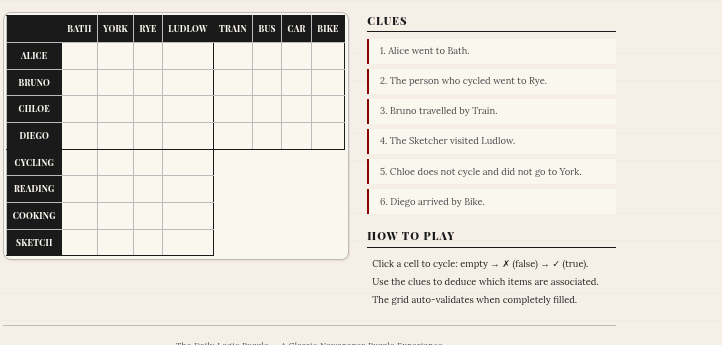
A logic grid puzzle drops you into a small mystery. Five people live in five houses, each with a different pet, a different favourite drink, and a different hobby. You are given a handful of clues — "The cat owner drinks tea," "Anna does not live in the red house" — and your job is to deduce who is who.
No trivia, no vocabulary, no luck. Just clues, a grid, and pure reasoning. If you have ever enjoyed a detective story, a logic grid puzzle lets you be the detective.
How the grid works
The grid is a set of intersecting tables, one for each pair of categories. Each row represents one item in a category and each column represents one item in another. You fill each cell with one of three states:
- True (✓) — this pair goes together.
- False (✗) — this pair does not go together.
- Empty — you have not decided yet.
The grid is a bookkeeping tool. It exists so you do not have to hold every clue in your head — you record each fact once, and the grid remembers it for you.
The golden rule: one true kills the row
Here is the single most important principle in logic grid puzzles: if a cell is true, every other cell in its row and column is false.
If Anna owns the cat (✓), then Anna owns no other pet, and no one else owns the cat. The moment you mark one cell true, you immediately cross out every other option in that row and column. This cascading elimination is the engine that solves the puzzle.
A four-step method
Step 1: Read every clue first
Do not start marking anything yet. Read all the clues and get a feel for what you are working with. Sort them mentally into two types:
- Direct (positive) clues — "Anna owns the cat." These give you a true (✓) immediately.
- Negative clues — "The cat owner does not drink tea." These give you a false (✷).
Some clues are conditional ("If Anna owns the cat, then she drinks tea") and can be ignored until their condition is met.
Step 2: Mark the direct clues
For every positive clue, mark the cell true and then immediately cross out the rest of its row and column. A few direct clues at the start can fill a surprising amount of the grid.
Step 3: Apply negative clues
For every "is not" clue, mark a false. Negative clues rarely solve anything on their own, but they thin the candidates — and a thinned grid reveals hidden deductions.
Step 4: Look for forced moves
Once you have marked what you can, scan for two patterns:
- Single empty cell in a row or column. If a row has four cells marked false and one left empty, that empty cell must be true. Mark it true, then cross out its row and column, and repeat.
- Only one possible home for an item. If a category has four of five items placed, the fifth must go in the only remaining slot.
These forced moves cascade. Each one you mark unlocks the next, and the grid fills itself in a chain reaction.
Worked mini-example
Suppose three people — Anna, Ben, and Cara — each own one pet: a cat, a dog, or a fish. The clues are:
- Anna does not own the dog.
- Ben owns the fish.
- Cara does not own the cat.
From clue 2: Ben → fish is true. Cross out Ben→cat, Ben→dog, Anna→fish, Cara→fish.
From clue 1: Anna → dog is false. Anna's only remaining option (since fish is gone and dog is false) is cat. Mark Anna→cat true. Cross out Cara→cat.
From clue 3: Cara → cat is false (already done). Cara's only remaining option is dog. Mark it true.
Solved in three steps, no guessing. That is the whole method, scaled up.
Common pitfalls
- Marking a guess as certain. If you are not sure, leave the cell empty. A false assumption poisons every deduction that follows.
- Forgetting to cross out the row and column. The cascade only works if you apply the golden rule every time you mark a true. Get into the habit: mark true, then immediately sweep the row and column.
- Missing negative clues. "Anna is not the swimmer" is just as useful as "Ben is the swimmer" — it removes an option. Do not skip the "is not" clues.
- Getting stuck and guessing. If you cannot find a move, you have missed a deduction — go back and re-read the clues, or check whether a row has a single empty cell you overlooked. Every logic grid puzzle is solvable by pure reasoning.
Why logic grids are so satisfying
Unlike a crossword (which rewards knowledge) or a Sudoku (which rewards pattern-spotting), a logic grid puzzle rewards something more like detective work: careful reading, patient elimination, and the discipline to record every fact. There is a particular pleasure in reaching the solution and knowing that every cell was placed by logic, not luck — that you could not have been wrong, because every step was forced.
They are also a gentle introduction to formal reasoning. The skills a logic grid exercises — reading premises, eliminating impossibilities, drawing conclusions that must follow — are the same skills used in mathematics, law, programming, and science, just presented as a game.
Ready to deduce?
Our free daily logic grid puzzle serves a fresh mystery every day across four difficulty levels. Start on Easy to learn the method, then watch the grids grow larger and the clues grow subtler as you climb. Once the four-step method clicks, you will find yourself solving puzzles you once thought impossible — and enjoying every deduction along the way.