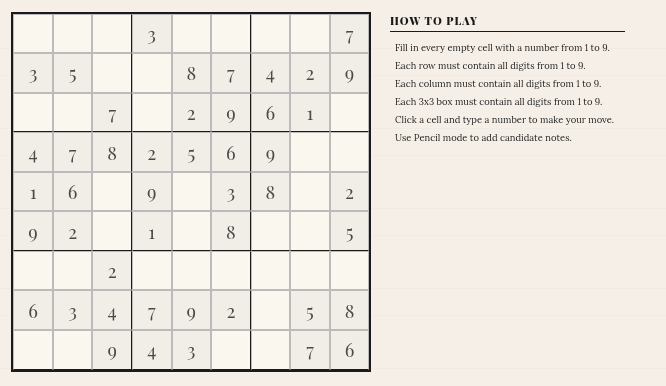
Sudoku looks like a numbers puzzle, but it is nothing of the sort. There is no maths, no arithmetic, and no calculation. It is a pure logic puzzle: every grid has a single unique solution, and you can always reach it by reasoning — never by guessing. The trick is knowing which techniques to reach for as the puzzles get harder.
This guide walks through seven solving methods, starting with the basics a complete beginner can use on day one and finishing with the patterns that unlock Expert-level grids.
The rules in thirty seconds
Fill the 9×9 grid so that every row, every column, and every one of the nine 3×3 boxes contains the digits 1 to 9 exactly once. That is the whole rulebook. Given numbers (the "givens") are fixed; everything else is yours to deduce.
1. Scanning
The first technique every solver learns. Pick a digit — say, 7 — and look at where the 7s already sit. Each existing 7 blocks every empty cell in its row, column, and box. Scan a single 3×3 box: if the row and column blockers leave only one possible cell for a 7 in that box, the 7 must go there. Scanning solves most Easy puzzles on its own.
2. Naked singles
A naked single is a cell that has only one possible candidate left. To find one, look at an empty cell and eliminate every digit already present in its row, column, and box. If only one digit remains, that digit goes in the cell. This is where pencil marks help: note the candidates in each empty cell (press P in our game to toggle pencil mode) and naked singles jump out immediately.
3. Hidden singles
A hidden single is subtler. It is a digit that can go in only one cell within a row, column, or box — even though that cell might have several other candidates pencilled in. To find one, pick a digit and a unit (a row, say) and ask: how many cells in this row could hold this digit? If the answer is one, that cell takes the digit. Hidden singles are the workhorse of Medium puzzles.
4. Naked pairs
If two cells in the same row, column, or box have exactly the same two candidates — both can only be 3 or 7, for instance — then 3 and 7 must occupy those two cells between them. That means you can eliminate 3 and 7 from every other cell in that unit. Naked pairs rarely solve a cell directly, but they strip away candidates that unlock naked and hidden singles elsewhere.
5. Pointing pairs and box-line reduction
Sometimes a candidate within a 3×3 box is restricted to a single row or column. If, for example, all the possible 5s in a box sit in the same row, then one of those cells must contain the 5 — which means no other cell in that row (outside the box) can hold a 5. Eliminate them. This "pointing pair" technique bridges the gap between singles and the more advanced patterns.
6. X-Wing
The X-Wing is the first truly advanced technique, and it is enormously satisfying to spot. It occurs when a candidate appears in exactly two cells in each of two rows, and those four cells line up in exactly two columns. The logic: in each of the two rows, the candidate must be in one of two cells — and since those cells share two columns, the candidate must occupy one cell in each column. That means you can eliminate the candidate from every other cell in those two columns. X-Wings unlock Hard and Expert puzzles that resist all the simpler methods.
7. Swordfish and beyond
The Swordfish extends X-Wing logic to three rows and three columns: if a candidate appears in exactly three cells across each of three rows, and those cells align in three columns, you can eliminate the candidate from the rest of those columns. Beyond Swordfish lie techniques like Jellyfish (four-by-four), XY-Wing, and Unique Rectangle — each more specialised. Most published Expert puzzles yield to X-Wing and Swordfish combined with patient elimination.
How to practise
The best way to internalise these techniques is to apply them in order:
- Scan the whole grid for obvious placements.
- Fill in pencil marks for every empty cell.
- Hunt for naked and hidden singles — these solve most of the grid.
- When you stall, look for naked pairs and pointing pairs to thin the candidates.
- Only then reach for X-Wing and beyond.
You will find that the leap from Easy to Medium is mostly about hidden singles, from Medium to Hard is about pairs, and from Hard to Expert is about spotting advanced patterns. Each threshold feels impossible until the technique clicks — then it becomes second nature.
Ready to practise?
The best teacher is repetition. Our free daily Sudoku serves a fresh puzzle every day across four difficulty levels, with pencil marks built in. Start on Easy until scanning is automatic, then climb.
Remember: a valid Sudoku always has exactly one solution, and you can always reach it by logic alone. If you ever feel the need to guess, you have missed a deduction — go back and look again.