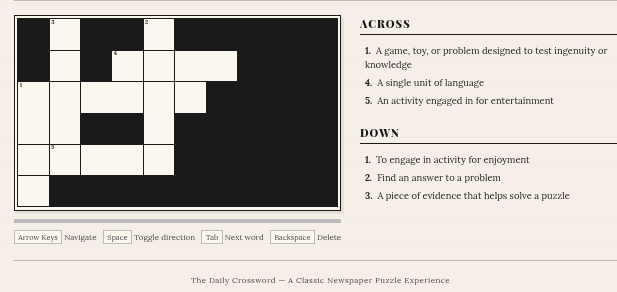
The crossword is the most widely played word puzzle in the world. Millions of people solve one every day — over coffee, on a commute, before bed. Yet this daily ritual is barely a century old, and it began with a single diamond-shaped grid printed in a New York newspaper on a quiet Sunday in December 1913.
The first crossword
The crossword was invented by Arthur Wynne, a journalist from Liverpool, England, who had emigrated to the United States. On 21 December 1913, the New York World's Sunday supplement published a puzzle Wynne called a "Word-Cross." It was diamond-shaped, with numbered clues and interlocking words, and it sat in a section of the paper meant for light entertainment.
Wynne's inspiration was a much older puzzle type from his childhood in England: the "word square," in which the same words read across and down. His innovation was to let the words differ, to separate them with black squares, and to give each its own clue. It was a small twist, but it created something entirely new.
Readers loved it. Within weeks the World was flooded with requests for more, and "Word-Cross" became a weekly feature. The name was soon accidentally reversed to "Cross-Word," and eventually the hyphen was dropped.
The 1920s craze
For a decade the crossword remained a single-newspaper curiosity. Then, in 1924, the fledgling publisher Simon & Schuster printed the first ever book of crossword puzzles. To the publishers' own surprise, it became a bestseller. Crossword fever swept the United States: department stores reported employees sneaking off to solve during working hours, and one woman sued her husband for divorce citing his crossword obsession.
By the late 192s, most major American newspapers carried a daily puzzle. The New York Times — which had initially dismissed crosswords as "a primitive sort of mental exercise" — held out until 1942, when it finally introduced its own. The Times crossword would go on to become the gold standard of the form.
Two traditions: American and British
As crosswords spread, two distinct styles emerged.
American-style crosswords use straightforward (or "definition") clues. A clue like "Feline pet (3)" simply wants the word CAT. The grids are open, with words crossing at many letters, and every square is checked — meaning each belongs to both an Across and a Down word.
British-style or cryptic crosswords, which developed in the UK, are famous for their fiendish clues. A cryptic clue packs two parts into a single line: a straight definition and a wordplay puzzle (an anagram, a hidden word, a reversal, a charade of smaller words). For example, the clue "Hearsay about endless party (4)" hides the answer RUM inside "RUMour," indicated by "endless." Cryptic clues read like nonsense until you crack the wordplay, then suddenly make perfect sense. To this day, the Guardian, the Times, and the Telegraph publish daily cryptics with devoted followings.
The crossword today
A century after Wynne's diamond, the crossword is everywhere: in print, in apps, in daily email newsletters. Competitions like the American Crossword Puzzle Tournament, founded in 1978, draw hundreds of solvers each year. Constructors (the people who build crosswords) are celebrated in their own right, and a Tuesday New York Times byline is a career milestone.
The form has evolved, too. Variant puzzles — themed, mini, diagramless, and cryptic — keep the format fresh. Online solving has made puzzles social, with leaderboards and shared solve-times. And research suggesting that regular mental stimulation may help maintain cognitive health has given older solvers a reason to feel good about their daily habit.
Why the crossword endures
Plenty of puzzles have come and gone since 1913. The crossword survives because it rewards so many different kinds of thinking at once: vocabulary, general knowledge, wordplay, pattern recognition, and patient deduction. A good crossword is a conversation between you and its setter — a small daily meeting of minds that you can have alone, in a few quiet minutes, almost anywhere.
If you have never tried one, our free daily crossword is a friendly place to start. The clues are straightforward (American-style) rather than cryptic, and there are four difficulty levels so you can begin gently and work your way up. Arthur Wynne would recognise the idea instantly — even if the screen would surprise him.