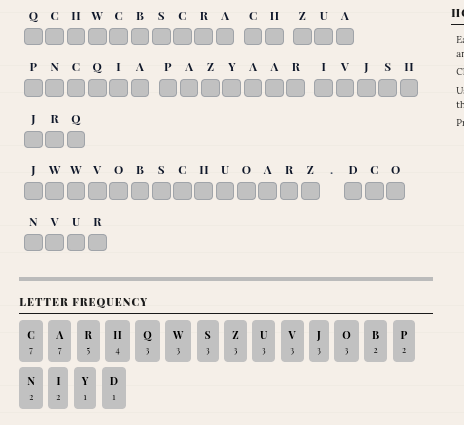
A cryptogram looks intimidating at first glance — a scrambled wall of letters that seems impossible to read. But every cryptogram is simply a substitution cipher: each letter of the alphabet has been swapped for a different letter, and the same swap is used throughout the whole message. Your job is to work out the swap and reveal the hidden quotation.
The reassuring truth: you never need to guess. Every cryptogram can be cracked with logic and pattern recognition. This guide walks you through the method, step by step, with a worked example.
How a substitution cipher works
Imagine a key that says A→Q, B→M, C→P, and so on for all 26 letters. The sentence "CAT" becomes "PQM". To decrypt, you reverse the mapping: every Q is really an A, every M is a B, every P is a C.
In a cryptogram puzzle, you are given the ciphertext (the scrambled letters) and must figure out the mapping yourself. The key insight is that the structure of English gives the cipher away.
The five-step method
Step 1: Count letter frequencies
English letters appear at very predictable rates. The most common letters, in order, are roughly:
E, T, A, O, I, N, S, H, R, D, L, U
The most frequent cipher letter in your puzzle is very likely E, the next most frequent is likely T or A, and so on. Most cryptogram puzzles show a frequency table beside the grid — start there. If the cipher letter X appears more often than any other, try mapping X→E and see what happens.
Step 2: Find the short words
Short words are the cipher's weak point because there are very few of them.
- One-letter words can only be A or I. If you see a lone cipher letter standing as a word, it is almost certainly one of these.
- Two-letter words are drawn from a tiny set: it, in, is, to, of, an, at, as, be, he, we, me, my, no, so, do, go, or, by, on, up.
Spot a two-letter cipher word and you immediately have a candidate for two letters at once. If you guess it is "TO", then the first cipher letter maps to T and the second to O — and every other occurrence of those cipher letters in the puzzle updates too.
Step 3: Watch for apostrophes
If your cryptogram contains apostrophes (many do, since they hide quotations), they are gold. An apostrophe in English almost always signals a contraction:
- 's → is, was, has (e.g. "it's", "he's")
- n't → not (e.g. "don't", "can't")
- 'll → will (e.g. "they'll")
- 're → are (e.g. "we're")
- 've → have (e.g. "I've")
An apostrophe immediately tells you the letter after it. If you see a cipher word ending in 'F, and you have already worked out that F might be S, then the word likely ends in 's — confirming your guess.
Step 4: Use letter patterns
When a letter repeats within a cipher word, the real word must repeat a letter in the same positions. This pattern-matching narrows candidates dramatically.
For example, the cipher word B X B D B has the pattern 1-2-1-3-1 (the same letter in positions 1, 3, and 5). What five-letter English words fit? Level and radar are the obvious ones. If one of those letters is already partly solved, the answer often jumps out.
Doubled letters are especially helpful. The common double-letter pairs in English are LL, EE, SS, OO, TT, FF, RR, NN, PP, MM. A doubled cipher letter is very likely one of these.
Step 5: Guess and verify
Once you have a few letters mapped, make tentative guesses and check them against the rest of the puzzle. If you map cipher Q→E, does that produce sensible fragments elsewhere? If a guessed letter creates a word like "QXZJV", your guess is wrong — back it out. If it creates "THE" or "AND", you are on the right track.
Each correct letter cascades: it fills in every occurrence of that cipher letter across the whole message, which reveals new word fragments, which suggest new letters.
A worked example
Suppose the cryptogram begins:
X P B A B M B C D B A E F G
Start with the pattern. The cipher word has B in positions 3, 5, and 7 — a 1-2-3-4-3-6-3-8-9-3-4-11-12-13 shape. Wait, let us focus on the first word: X P B A B M B C. Here B repeats in positions 3, 5, and 7. A common eight-letter English word with the same letter in positions 3, 5, and 7 is... THINKING? No. Try simpler: what about a word where the third, fifth, and seventh letters match?
Rather than wrestle an eight-letter word, look for shorter patterns and high-frequency letters first. Count how often each cipher letter appears across the whole message; map the most frequent to E; find a one- or two-letter word to confirm. The first crack is always the hardest — after that, the puzzle unravels quickly.
Tips for your first few solves
- Start with the frequency table, not the words. It gives you the safest first guess.
- Fill in one letter at a time and watch the puzzle update. Each letter is feedback.
- Use hints sparingly. A single revealed letter can break open a stuck puzzle.
- Expect quotations. Most cryptograms hide famous sayings, so once you have a few words, the rest often suggests itself.
Ready to try?
The best way to learn is to do it. Our free daily cryptogram hides a fresh quotation every day, with a built-in frequency table and three hints per game. Start with an Easy puzzle, follow the five steps above, and you will have your first decode within minutes. Once the method clicks, you will wonder why cryptograms ever looked hard.