There is a familiar promise attached to puzzles: do one every day and you will keep your mind sharp. It is an appealing idea, and there is real science behind it — though the truth, as usual, is more interesting than the headline. This article looks at what research actually suggests about puzzles and the brain, and how to get the most cognitive value from your daily solve.
What studies suggest
Research on puzzles and cognition falls broadly into two camps, and both are relevant.
Cross-sectional studies compare people who already do puzzles with people who do not. These consistently find that regular puzzle-solvers perform better on tests of memory, attention, processing speed, and reasoning. The catch is obvious: cause and effect are hard to untangle. People who enjoy puzzles may simply have started out with stronger cognitive skills.
Longitudinal studies are more convincing. The most widely cited is the 2019 Liverpool Longitudinal Study, led by Dr. Anne Corbett at the University of Exeter, which tracked more than 19,000 participants over time. It found that adults who regularly did word puzzles (like crosswords) showed brain function equivalent to someone roughly ten years younger on tests of attention, reasoning, and memory. A separate body of research on Sudoku specifically has linked regular play to improvements in working memory and logical reasoning.
A landmark 2013 study from the University of Iowa found that older adults who engaged in regular "brain training" tasks — including puzzle-like reasoning exercises — showed measurable improvements that lasted for at least five years. The effect sizes were modest but real, and they accumulated.
What puzzles probably do not do
It is important to be honest about the limits. Puzzles are not a cure for cognitive decline, and they are not a substitute for the lifestyle factors that matter most for brain health:
- Physical exercise, which improves blood flow to the brain and is the single best-supported intervention for long-term cognitive health.
- Sleep, during which the brain consolidates memory and clears metabolic waste.
- Social connection, which protects against cognitive decline more robustly than any solo activity.
- A varied diet, learning new skills, and managing blood pressure and stress.
Puzzles are best understood as one piece of a broader picture — a way to give your mind regular, enjoyable exercise, not a magic shield.
Why variety matters
An important finding from the cognitive-training literature is that the benefits of a mental task are largely specific to the skill it exercises. People who practise Sudoku get better at Sudoku — and at tasks that tax similar logical-reasoning muscles — but the gains do not necessarily transfer to, say, remembering names or learning a language.
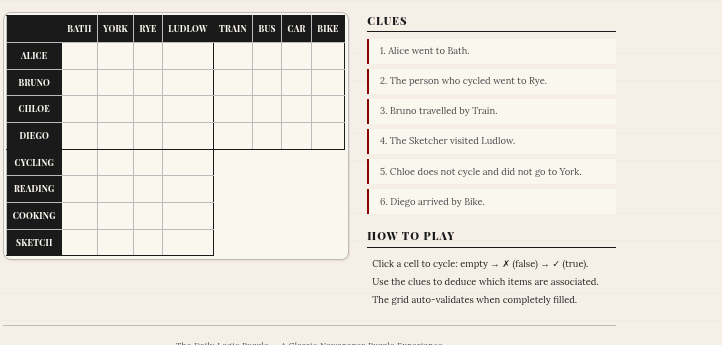
This is why a variety of puzzles is more valuable than doing the same one every day. A Sudoku exercises logic and working memory. A crossword exercises vocabulary retrieval and general knowledge. A logic grid puzzle exercises systematic deduction. A word search exercises visual scanning speed. A maze exercises spatial planning. Each works a slightly different cognitive system, so a balanced puzzle diet engages more of the brain than solving only one type.
The flow state, and why it matters
There is a less-measurable but very real benefit to puzzles that the studies struggle to capture: they reliably produce a state of focused calm. When you are deep in a Sudoku, the rest of the world quiets. Psychologists call this flow — the state of complete absorption in a challenging-but-achievable task — and it is associated with reduced stress, improved mood, and a sense of satisfaction.
For many people, this is the real reason they solve puzzles. Not because they are "training their brain" in any clinical sense, but because fifteen minutes of focused logic is genuinely restorative in a day full of distractions.
How to build a healthy puzzle habit
If you want puzzles to be part of your cognitive routine, here is what the evidence suggests:
- Solve a little, often. Fifteen minutes a day beats a two-hour binge once a week. Consistency matters more than intensity.
- Mix the types. Rotate between word, logic, and spatial puzzles so you exercise different mental systems.
- Increase the challenge. A puzzle that is too easy is pleasant but not stretching. Gradually push toward harder difficulty levels so the task stays just beyond comfortable.
- Enjoy it. The cognitive benefits of a puzzle you find tedious are probably smaller than those of one you genuinely look forward to — because you will do it more often and for longer.
The bottom line
Daily puzzles are a small, enjoyable, low-risk habit with genuine — if modest — cognitive benefits, especially as part of a lifestyle that also includes exercise, sleep, and social engagement. They will not make you a genius, and they will not stop ageing. But they will keep your reasoning, vocabulary, and attention in regular, pleasant practice. That is a fine reason to do one today.
Want to get started? Our free daily puzzle rotates across every type we offer — Sudoku, crosswords, logic grids, and more — so a single daily habit naturally gives you the variety the research recommends.